

The bottom line: Beehiiv is the clear winner for newsletter-first creators focused on growth and monetization, while Kit remains the superior engine for selling digital products via complex automation funnels. Beehiiv offers a significant financial advantage with flat-rate pricing, making it the sustainable choice for scaling content. Kit’s higher price point is only justified if advanced segmentation is strictly necessary. Crucially, Beehiiv’s Scale plan covers up to 100,000 subscribers for a flat $42/month, a fraction of Kit’s cost for the same volume.
Are you paralyzed by the Beehiiv vs Kit decision because you fear locking your business into a platform that drains your budget without delivering actual growth? This honest comparison strips away the marketing fluff to analyze the real-world differences between Beehiiv’s flat-rate newsletter engine and Kit’s advanced automation toolkit for digital product sales. You will discover exactly which infrastructure matches your specific goals and how choosing the wrong provider today could cost you thousands in unnecessary subscription fees as your audience finally begins to scale.
- A Quick Look: Beehiiv vs Kit Summary
- What Is Beehiiv? The Newsletter Growth Machine
- What Is Kit? The Complete Creator’s Toolkit
- Beehiiv vs Kit: A Feature-by-Feature Breakdown
- Beehiiv vs Kit: Pricing Compared at Scale
- What Users Are Saying: Beehiiv vs Kit Reviews
- The Final Verdict: Should You Choose Beehiiv or Kit?
A Quick Look: Beehiiv vs Kit Summary
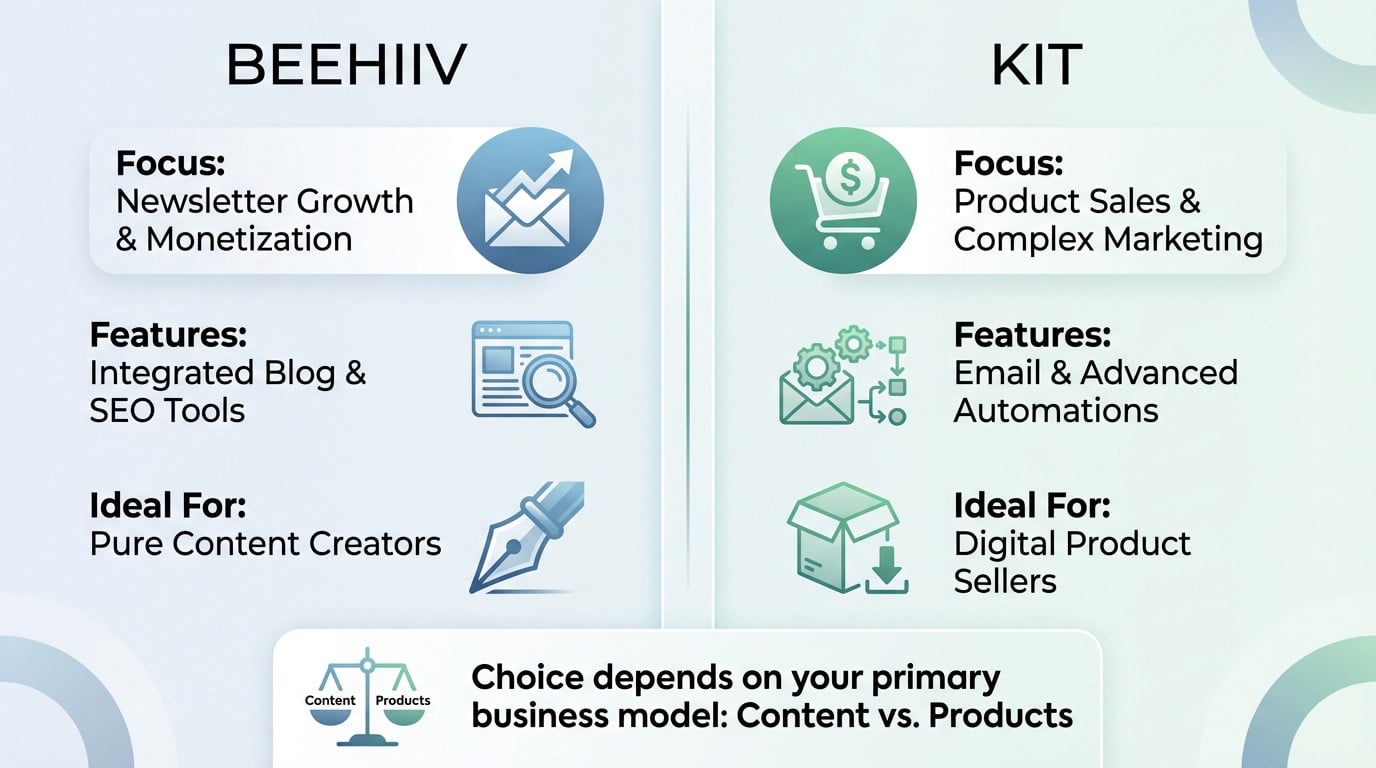
Let’s cut the noise immediately. Beehiiv is strictly for creators obsessed with scaling a newsletter and cashing in on ads. Kit acts as a heavy-duty engine for selling digital products and running complex marketing workflows.
Forget asking which tool is “better” in a vacuum. The real question is whether your business runs on pure content volume or intricate digital product funnels.
Below, I’ll rip apart the actual feature sets and pricing traps. We are going to look at the raw data. You might be overpaying for features you don’t need.
Beehiiv functions as a full publication platform with a blog and SEO tools built right in. Kit sticks to email and advanced automations, meaning you will likely need a separate website to handle your actual content pages.
Don’t guess with your monthly budget. Read on to see which platform actually fits your specific workflow.
What Is Beehiiv? The Newsletter Growth Machine
Most tools force you to glue plugins together. Beehiiv is different because it’s a purpose-built ecosystem for newsletter creators. It consolidates your website, SEO infrastructure, and email sending into one all-in-one platform designed purely for scaling.
You won’t need a PhD to navigate the dashboard. The interface is intentionally clean and modern, a sharp contrast to the clunky, legacy software that has dominated this space for the last decade.
Here is where they actually disrupt the market. You get built-in access to a premium Ad Network, paid subscriptions with 0% platform fees, and “Boosts” for cross-promotion. It turns your writing into a revenue stream immediately.
Beehiiv isn’t just an email tool; it’s a growth engine that combines your newsletter, website, and monetization streams into one clean, manageable dashboard.
Most creators lose hours trying to hack together referral systems. Beehiiv handles this natively with integrated growth tools like a recommendation network and referral program that actively drives new subscribers without you touching a single line of code.
The barrier to entry is effectively zero. Their “Launch” plan lets you run up to 2,500 subscribers for free, giving you ample runway to validate your content before paying a dime.
If your primary product is the newsletter, this is the architecture you want. It removes the technical friction so you can focus entirely on the writing.
What Is Kit? The Complete Creator’s Toolkit
You likely know this platform by its legacy name, ConvertKit, a staple in the industry. The recent strategic rebrand to Kit signals an ambition far greater than simple email marketing. It is now a full-stack operating system designed for serious, scaling creators.
The engine room runs on a best-in-class visual automation builder that visualizes the user journey. You can design complex logic branches based on specific user behaviors, not just opens. This makes it the superior choice for building intricate, high-converting sales funnels.
Kit eliminates the need for third-party checkout tools by handling digital product sales natively. You can sell e-books, coaching, or courses directly within the infrastructure without complex integrations. It is a robust, built-in function, meaning you stop losing data between disparate apps.
The ultra-flexible tagging system is the platform’s true signature feature. It allows surgical targeting that outclasses standard lists seen in many comparisons with other tools. You segment audiences based on precise actions, giving you granular control over exactly who sees what content.
Kit is engineered specifically for professional creators—bloggers, podcasters, and course creators—who manage a complete business ecosystem. It handles the heavy lifting for those running a business, not just a newsletter.
However, this raw power creates a steeper learning curve. The interface is denser and often feels intimidating compared to modern, minimalist alternatives. You trade simplicity for functionality, which is a friction point for beginners who just want to write.
Ultimately, Kit serves as a “control room” for creators requiring maximum leverage. If you need power and flexibility above all else, this is your toolkit.
Beehiiv vs Kit: A Feature-by-Feature Breakdown
Now that the introductions are out of the way, let’s see how these two platforms compare on the ground. Here is a direct summary of the functionalities before digging into the details.
| Feature | Beehiiv | Kit |
|---|---|---|
| Email Editor | ✅ Modern, simple, and intuitive editor. ❌ Less flexibility in design. | ✅ Highly flexible for text-based emails. ❌ Visually basic, not ideal for image-heavy newsletters. |
| Automation | ✅ Basic automations for welcome series. ❌ Not powerful enough for complex funnels. | ✅ Industry-leading visual automation builder. Perfect for intricate sales funnels. |
| Monetization | ✅ Built-in Ad Network, paid subscriptions (0% fee option), boosts. Superior native tools. | ✅ Strong for digital product sales. ❌ Relies on creator finding their own sponsors. |
| Growth Tools | ✅ Integrated referral program and recommendation network. | ✅ Powerful landing pages and forms, but requires more manual promotion. |
| Website/Blog | ✅ All-in-one platform with built-in, SEO-optimized website. | ❌ Primarily offers landing pages. Requires a separate tool (like WordPress) for a full blog. |
| Segmentation | ✅ Basic segmentation. Good enough for most. | ✅ Advanced tag-based system for hyper-specific targeting. |
| Analytics | ✅ Detailed 3D analytics linking engagement to revenue. | ❌ Reporting is considered less detailed than competitors. |
The table shows a clear division. Beehiiv integrates growth and content, while Kit focuses on automation and sales.
Monetization and Growth: Beehiiv’s Unfair Advantage
Beehiiv was built with monetization at its core. Its integrated ad network is a major asset, directly connecting creators with potential sponsors without the need for cold outreach.
Paid subscriptions are also more profitable here. On the Scale plan, Beehiiv takes zero transaction fees, unlike the standard cuts you lose on other platforms.
Growth tools like the native referral program and the “Boosts” recommendation network are designed to create a flywheel effect. Your audience actually works to help you grow, rather than you doing all the heavy lifting alone.
Here is exactly what you get out of the box:
- Beehiiv’s Core Monetization Tools:
- Paid Subscriptions (with a 0% fee plan)
- Integrated Ad Network to find sponsors
- “Boosts” for paid cross-promotion with other newsletters
Automation and Segmentation: Where Kit Shines
If your strategy relies on sales funnels, Kit is in another league. Its visual automation builder allows you to construct customer journeys of a complexity that Beehiiv simply cannot match.
The real power comes from its tag-based system. You can segment your subscribers based on every click, purchase, or page visited, allowing for marketing that surpasses Beehiiv in audience segmentation.
This is what allows you to create dynamic “mini-lists” within your main audience. You can send a specific offer solely to those who clicked a particular link three weeks ago, ensuring you don’t burn your list with irrelevant blasts.
In short, Kit isn’t just for sending emails. It serves to manage client relations at scale, with a granularity that few competitors can offer.
Content Platform: Beehiiv’s SEO Edge vs. Kit’s Landing Pages
This is a fundamental difference. With Beehiiv, every newsletter is also a blog post on your integrated website. This means your content is accessible via Google.
This integrated SEO advantage acts as a passive acquisition channel. People can discover your newsletter via a Google search years later, an asset that Kit does not offer natively.
Kit, on its side, excels in the creation of landing pages. It offers a vast library of templates to capture emails for specific products, but it is not a blog.
The choice is therefore clear: if you want your content to work for you long-term via SEO, Beehiiv has a structural advantage. If your focus is immediate conversion via dedicated pages, Kit is highly performant.
Beehiiv vs Kit: Pricing Compared at Scale
Features are one thing, but the monthly bill is where the reality of scaling actually hits you. The price tag you see on the homepage often hides a painful truth: one of these platforms penalizes you for growing, while the other keeps your margins safe.
| Subscribers | Beehiiv (Scale Plan) | Kit (Creator Plan) |
|---|---|---|
| Free Tier | Beehiiv: Up to 2,500 subs (Free) | Kit: Up to 1,000 subs (Free, limited features) |
| 3,000 subs | $42/mo | $49/mo |
| 10,000 subs | $42/mo | $119/mo |
| 50,000 subs | $42/mo | $379/mo |
| 100,000 subs | $42/mo | $679/mo |
| Prices are approximate based on public data and annual billing discounts. Beehiiv’s Scale plan covers up to 100k subscribers at a flat rate. Kit’s pricing scales with subscriber count. | ||
The table above is brutal if you care about overhead. Beehiiv is significantly more affordable the moment you move past the hobbyist stage, simply because they don’t tax your growth with incremental hikes.
It comes down to the flat-rate model. Beehiiv’s “Scale” plan stays at $42/month (billed annually) all the way to 100,000 subscribers. On Kit, maintaining a list of that exact same size on the “Creator” plan forces you to pay hundreds of dollars more.
For creators focused on list growth, Beehiiv’s flat-rate pricing is a massive financial advantage, while Kit’s model penalizes you for succeeding at scale.
That said, Kit isn’t trying to rip you off; they are charging for a different toolset. Their free entry point is decent for testing the waters, but remember that the automations, their primary asset, are locked until you open your wallet.
You need to make a cold, hard calculation based on your business model. If you plan on rapid subscriber acquisition and want to keep your revenue, the economic advantage of Beehiiv is undeniable. If your business runs on complex, high-ticket sales funnels, be prepared to pay Kit’s premium for that power.
- Key Pricing Tiers:
- Beehiiv Launch: Free for up to 2,500 subscribers.
- Beehiiv Scale: $42/month (paid annually) for up to 100,000 subscribers, includes monetization tools.
- Kit Free: Free for up to 1,000 subscribers, no automations.
- Kit Creator: Starts at $15/month, price increases with subscribers. Unlocks automations.
What Users Are Saying: Beehiiv vs Kit Reviews
Stats are fine, but daily user experience is what actually matters. The feedback on Beehiiv almost unanimously praises its simplicity and slick, modern interface. It does not feel like a chore to log in every day.
Heavy hitters like Growth Daily report it is “100 times easier” to manage multiple newsletters and track metrics on Beehiiv than on Kit. That is a sentiment I see constantly in B2B software reviews. It just works.
With Kit, the reviews are more split. Advanced marketers absolutely love the granular power and flexibility for automations. But many newcomers feel overwhelmed by a dashboard often described as “cluttered” or “busy.” It is not beginner-friendly.
Deliverability is frequently cited as Kit’s major stronghold. Its decade-long reputation and established infrastructure give it a slight edge for actually hitting the inbox. You are paying for that reliability.
- Common User Feedback – Beehiiv: ✅ Clean UI, easy to use. ✅ Great monetization tools. ❌ Less flexible automations.
- Common User Feedback – Kit: ✅ Powerful automations. ✅ Great for selling products. ❌ Steep learning curve, can be expensive.
The Final Verdict: Should You Choose Beehiiv or Kit?
So, Beehiiv or Kit? The answer depends entirely on your primary goal as a creator. There is no wrong choice here, only a misalignment that could cost you momentum and money later.
Choose Beehiiv if you are a “newsletter-first” creator. If your goal is building an audience around content, monetizing simply via ads, and leveraging SEO, Beehiiv is your tool. Their built-in recommendation network and 0% fees on premium subscriptions mean you keep more revenue while growing faster.
It is the most direct and profitable path for newsletter growth right now, offering a modern interface that makes writing daily content significantly less painful than legacy tools.
Choose Kit if you are a “creator-entrepreneur”. If you sell digital products or courses, and your marketing relies on automated sales funnels and granular segmentation. Kit excels here with its visual automation builder and over 100 direct integrations that Beehiiv simply cannot match yet.
It is the more powerful toolkit for building a complex sales machine, but be prepared for a steeper learning curve and a price tag that climbs quickly as your list grows.
One last point: portability. Both platforms let you export your list easily via CSV. But keep in mind that migrating Kit’s specific logic—like dynamic segments and intricate tag structures—is notoriously difficult to recreate elsewhere manually. You aren’t just moving data; you are moving a logic system.
Ultimately, evaluate your main need. Is it rapid content growth or complex sales automation? The answer lies there.
My Take
Based on the data: Choose Beehiiv if you’re a newsletter-first creator focused on growth and SEO. Pick Kit if you need complex automations to sell digital products. It’s not about the “best” tool, but the one that aligns with your specific business model.
FAQ
What is the main difference between Kit and Beehiiv?
The fundamental difference lies in their core focus. Beehiiv is a “newsletter-first” platform designed specifically for content growth, monetization via ads, and SEO. It treats the newsletter as the product itself. Kit (formerly ConvertKit) is a “creator-first” toolkit built for selling digital products (courses, ebooks) through complex automations and granular segmentation. Choose Beehiiv to scale a publication; choose Kit to build a sales engine.
Which is the best email newsletter platform for me?
If your goal is to build an audience and monetize directly through subscriptions or ads with a simple, modern interface, Beehiiv is currently the superior choice. However, if you are an advanced marketer needing to tag users based on specific link clicks to trigger intricate sales funnels for third-party products, Kit remains the industry standard for that level of technical control.
How does the pricing compare between Beehiiv and Kit?
Beehiiv is significantly more affordable at scale due to its flat-rate pricing structure. For example, the Scale plan covers up to 100,000 subscribers for roughly $42/month. In contrast, Kit charges per subscriber; a list of 100,000 people on their Creator plan would cost over $600/month. Beehiiv rewards growth, while Kit’s pricing model becomes a tax on your success as your list expands.
What is the cheapest newsletter platform?
For beginners, Beehiiv offers a more generous free plan, allowing up to 2,500 subscribers compared to Kit’s 1,000. As you grow, Beehiiv remains the cheaper option by a wide margin. While Kit is a powerful tool, you pay a premium for its advanced automation features, which many newsletter-focused creators simply do not need.

SEO consultant and solopreneur since the late 1990s. Europe-based, running an Estonian OÜ.
I review SEO and SaaS tools from a working consultant’s perspective—not as a professional reviewer. My content comes from three approaches, and I’m always transparent about which:
• Deep experience (10%): Tools I use regularly in client work
• Brief testing (20%): Tools I’ve tested for days or weeks
• Research-based (70%): Analysis of 200+ user reviews, documentation, and competitor comparisons
After 25+ years in this industry, I’ve seen every “revolutionary” tool come and go. I know what works, what’s hype, and what questions to ask.
Affiliate links are present throughout the site. Small commission if you buy (no extra cost to you). I also mention better alternatives even when I don’t get paid.