

The bottom line: This comparison comes down to organizational scale rather than feature counting. Salesforce operates as a massive, complex ecosystem for enterprises requiring total customization across departments, whereas Pipedrive serves as a surgical, sales-first tool designed purely for pipeline velocity. Selecting the right platform prevents overpaying or hitting a functionality ceiling later. While Salesforce demands a dedicated administrator and significant budget, Pipedrive delivers immediate team adoption, proving that for pure sales execution, a focused race car often outperforms a heavy engine.
Is your sales team paralyzed by a CRM that requires a degree to operate, or are you losing deals because your current tool is simply too basic for your ambition? This no-nonsense Salesforce vs Pipedrive comparison cuts through the enterprise marketing hype to reveal whether you actually need a complex ecosystem or a streamlined sales pipeline. I have analyzed the hidden pricing structures and usability feedback to help you avoid an expensive mistake and choose the platform that fits your actual workflow.
- A Quick Verdict on Salesforce vs Pipedrive
- Feature Breakdown: The Engine vs The Race Car
- Salesforce vs Pipedrive: The Price Tag Shock
- What Real Users Say: The Good, The Bad, and The Heavy
- So, Should You Buy Salesforce or Pipedrive?
A Quick Verdict on Salesforce vs Pipedrive
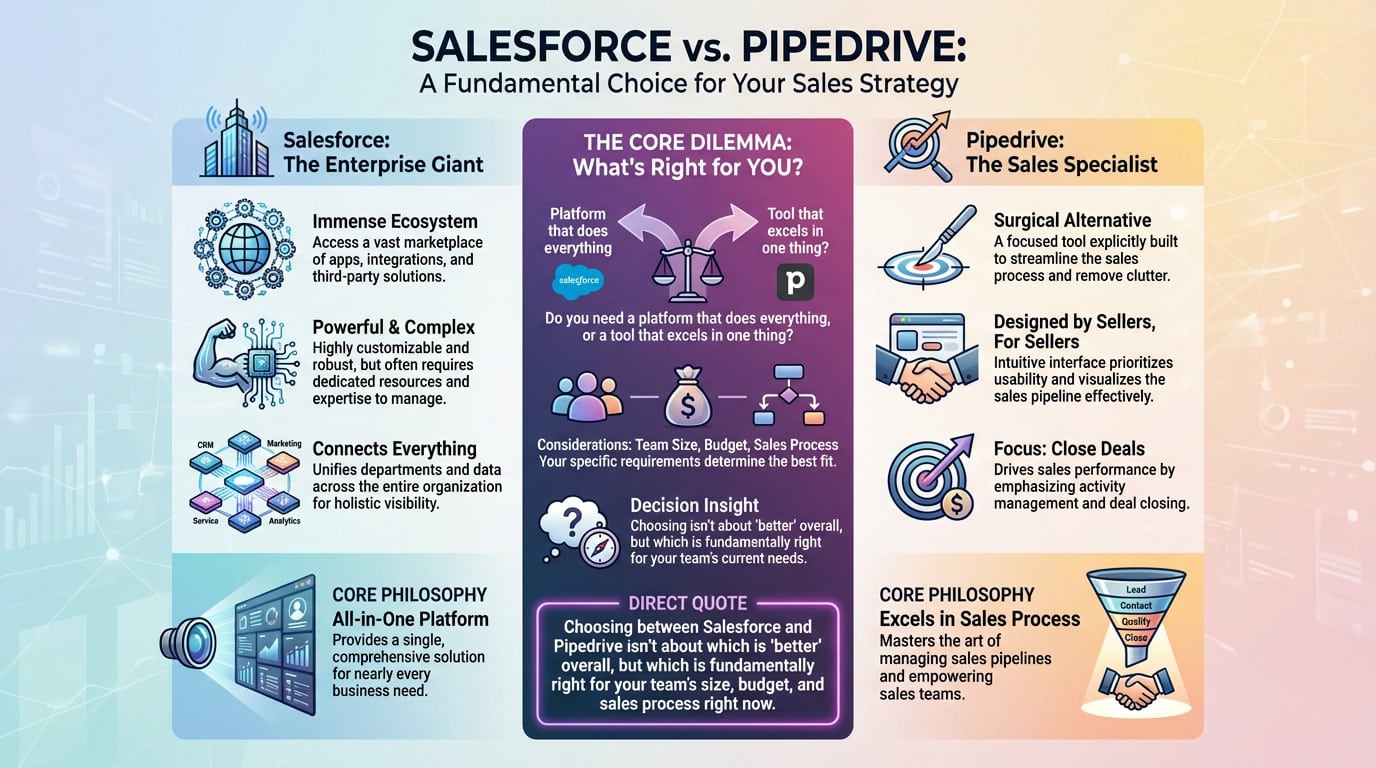
Let’s be brutally honest right now. Salesforce isn’t just a tool; it is a sprawling ecosystem designed for massive enterprises needing to connect every single data point. It is a total war machine. But that power brings crushing complexity.
Pipedrive is the surgical alternative. It was built by salespeople who hated clunky software, so its only goal is helping you close deals faster. No bloat, just pure sales focus.
Your choice isn’t about features; it is about philosophy. Do you actually need a platform that does everything, or a specialized tool that excels at one thing? Most get this wrong.
Below, I will dissect the concrete differences that matter to your wallet. We are talking real pricing, actual ease of use, and who each tool is truly built for today.
Choosing between Salesforce and Pipedrive isn’t about which is ‘better’ overall, but which is fundamentally right for your team’s size, budget, and sales process right now.
Feature Breakdown: The Engine vs The Race Car
Now that the stage is set, let’s pop the hood. We need to see if you need a complex engine or a streamlined race car.
| Feature | Salesforce | Pipedrive |
|---|---|---|
| Core Philosophy | ✅ All-in-one platform for the entire customer lifecycle (Sales, Service, Marketing). | ✅ Sales-first CRM focused on activity-based selling and pipeline visualization. |
| Pipeline Management | ✅ Highly customizable stages and processes. ❌ Can be complex to set up and manage. | ✅ Extremely intuitive, visual drag-and-drop pipeline. The core of the product. |
| Customization | ✅ Nearly limitless. Custom objects, fields, workflows, and entire applications. | ✅ Good customization for sales processes. ❌ Limited beyond sales-specific needs. |
| Automation | ✅ Powerful, enterprise-grade workflow rules and Process Builder. Steep learning curve. | ✅ Simple, effective workflow automation for sales tasks (e.g., send email when deal moves). |
| Integrations | ✅ Massive ecosystem via the AppExchange with thousands of apps. | ✅ Solid marketplace with key integrations, but smaller than Salesforce’s. |
| Reporting & Analytics | ✅ Deep, complex reporting capabilities with customizable dashboards. | ✅ Clear, sales-focused reports and dashboards. ❌ Less depth for complex enterprise analytics. |
Pipedrive’s Secret Weapon: Obsessive Simplicity
Pipedrive doesn’t try to do everything well; its strength lies in a focus obsessionnel sur le pipeline de vente. The entire interface is built around a single, obsessive goal: moving deals from left to right. The visual pipeline isn’t just a feature; it is the product. It cuts out the noise so you can focus on selling.
This tool forces you into a philosophy of “activity-based selling.” You can’t just stare at a revenue number; you have to schedule the next call or demo. It makes salespeople accountable for their daily actions rather than just end results.
Because it actually helps them sell, the adoption par les équipes beaucoup plus rapide is noticeable. You won’t need weeks of training or coercion. Sales reps use it because they want to, not because management demands it.
Salesforce’s Universe: Customization and Scale
With Salesforce, you have to shift your perspective; it isn’t a tool, it’s a platform where personnalisation est quasi infinie. You can mold the architecture to fit the most convoluted enterprise processes imaginable. If you can dream up a workflow, Salesforce can probably build it.
Then there is the AppExchange, which gives large enterprises an unfair advantage. Whatever niche problem you have, there is an app for it. It’s a massive selling point, similar to how Monday.com measures up to Salesforce in terms of ecosystem breadth.
But this power demands a blood sacrifice: complexity. You cannot just “set it up” over a weekend. You will likely need a ressources dédiées, often a certified Salesforce administrator, just to keep the lights on.
The Integration Question: Connecting Your Tools
Let’s talk about how data actually gets in: your web forms. How do leads from your website land in the CRM? It is a boring detail that trips up 90% of businesses.
Salesforce handles this with official, robust add-ons that plug directly into your site structure. It is incredibly stable, but setting it up feels like configuring a server. You get raw power, but you have to earn it with technical sweat.
Pipedrive often relies on connectors like Zapier to bridge that gap. It is far easier for a non-technical founder to configure, even if it means relying on a third-party glue.
Salesforce vs Pipedrive: The Price Tag Shock
Let’s be brutally honest here. The cost difference isn’t a minor gap; it’s a massive canyon. Salesforce is systematically more expensive at every single tier. And that sticker price you see? It is usually just the opening bid.
You need to understand their billing architecture. Prices hit you per user, per month, and often split by specific “Clouds.” Those stacking costs drain budgets faster than you expect.
Pipedrive takes a refreshingly different approach. Their tiers remain transparent and affordable, unlocking critical selling tools right from the start. You won’t face that dreaded billing hangover at the end of the quarter.
Ballpark Pricing Comparison (per user/month, billed annually):
- Pipedrive:
- Lite: Starts at $14. Simple pipeline and contact management.
- Growth: $39. Adds automation and email features.
- Premium: $59. More robust features like revenue forecasting.
- Salesforce (Sales Cloud):
- Starter: Starts around $25. Basic CRM for small teams.
- Pro Suite: $100. Adds forecasting and more customization.
- Enterprise: $175. The most popular tier, deep automation and customization.
Now, consider the financial iceberg beneath the surface. You must budget for implementation, training, and maintenance. It is never just about the license fee. The total cost of ownership climbs significantly higher with Salesforce.
Pipedrive offers the budget predictability that small businesses desperately need. You know exactly what you pay next month. Complex enterprise platforms simply cannot guarantee that stability.
What Real Users Say: The Good, The Bad, and The Heavy
Enough about what I think. Let’s look at what the people paying the invoices actually say.
On platforms like Gartner Peer Insights, both tools score high marks, though for opposing reasons. Salesforce secures a 4.4/5 rating, while Pipedrive trails slightly at 4.2/5. The numbers look close, yet they tell two completely different stories.
“Pipedrive is lightweight and no-frills, but it’s also incredibly slow and archaic… Salesforce is less slow than it was in 2015, but it’s still ‘heavy’.”
- Common User Feedback
- Pipedrive Pros: “Incredibly easy to use” and “intuitive” are the most common praises. “Visual pipeline is a game-changer for our sales team.”
- Pipedrive Cons: “Lacks features beyond pure sales.” “Can feel slow or buggy at times.”
- Salesforce Pros: “Infinitely customizable to fit any business process.” “The reporting is powerful if you know how to use it.”
- Salesforce Cons: “Steep learning curve, requires a dedicated admin.” “Expensive, and the contracts can be rigid.”
The sentiment is clear. Users adore Pipedrive for its raw simplicity and focus on action. Conversely, they respect Salesforce for its capability but frequently complain about its sluggishness and the high cost of ownership.
We are even seeing teams migrate from Salesforce to Pipedrive specifically to escape this complexity. As noted by Pipedrive’s co-founder in TechCrunch, businesses are actively seeking relief from “heavy” legacy systems.
So, Should You Buy Salesforce or Pipedrive?
Look, picking a winner here isn’t about features. It comes down to your company size and the complexity of your needs. Picking the wrong one burns cash. There is no bad choice, only a terrible alignment.
If you run a lean SMB or a growing startup, listen up. Your absolute priority is to give your sales team a tool they will actually use. Complex software kills momentum. The choice here is simple.
Who Should Choose
- Choose Pipedrive if:
- You are a small to medium-sized business (SMB).
- Your primary need is a sales pipeline management tool.
- Ease of use and quick team adoption are your top priorities.
- You have a limited budget.
- Choose Salesforce if:
- You are a large enterprise with complex processes.
- You need a single platform for sales, marketing, and customer service.
- You have the budget and technical resources for implementation and maintenance.
- Deep customization is a must-have.
For massive enterprises needing a full ERP and CRM integration, the conversation shifts. You might even be weighing options like HubSpot vs Odoo. But for pure sales velocity, simplicity often wins the day.
Here is the bottom line: for a sales crew that just wants to sell, check out Pipedrive. If your company needs a massive backbone for every single client operation, Salesforce is the market standard.
So, should you buy salesforce or pipedrive?
The decision rests on your company size and complexity. If you are an SMB wanting a tool your team will actually use, go check out Pipedrive. It is built for closing deals. However, if you need a massive enterprise backbone for complex operations, Salesforce is the standard.
FAQ
Is Pipedrive actually better than Salesforce?
It depends entirely on your scale. From my experience, Pipedrive is superior for small to mid-sized sales teams that need to start selling immediately without a six-month implementation phase. It is a focused race car designed specifically for closing deals.
Salesforce is the better choice only if you are a large enterprise needing a massive ecosystem to connect marketing, customer service, and complex custom workflows. It is a powerful engine, but unlike Pipedrive, it usually requires a dedicated mechanic (admin) to keep it running.
Why do companies migrate away from Salesforce?
The primary drivers are usually cost and “feature bloat.” I’ve seen businesses bleeding money not just on high license fees (which can scale up to $300/user), but on the expensive consultants required to maintain the system. The Total Cost of Ownership is often much higher than the sticker price.
Companies often leave because they realize they bought an overly complex platform when all they needed was a streamlined sales tool. They switch to Pipedrive to regain agility, reduce friction for their sales agents, and stop paying for enterprise features they never actually use.
Is Salesforce really the #1 CRM for everyone?
Salesforce is the market leader by revenue and the standard for the Fortune 500, but “biggest” does not mean “best fit” for your specific needs. In the world of software, market dominance often correlates with complexity.
For pure sales execution in SMBs, user reviews on platforms like Gartner Peer Insights often rate Pipedrive highly for its usability and quick setup. While Salesforce is the #1 generalist platform, Pipedrive is arguably the #1 specialist tool for pipeline management.
Is Pipedrive expensive compared to Salesforce?
No, quite the opposite. Pipedrive offers transparent pricing starting around $14 per user/month, and crucially, it rarely requires expensive external implementation or training costs. You know exactly what you are paying for.
Salesforce might appear to have a comparable entry-level price (around $25), but the costs scale aggressively with add-ons, necessary integrations, and “Cloud” tiers. When you factor in the hidden costs of implementation and administration, Salesforce is almost invariably the more expensive investment.
Which CRM do actual sales agents prefer?
In my testing and consulting work, sales agents almost universally prefer Pipedrive. Its visual Kanban pipeline and “activity-based selling” philosophy align with how salespeople actually think and work, rather than just how managers want to report.
Salesforce is often viewed by agents as a heavy administrative burden—a tool they are forced to feed data into. Pipedrive, by contrast, feels like a tool built to help them close deals, resulting in much higher natural adoption rates.

SEO consultant and solopreneur since the late 1990s. Europe-based, running an Estonian OÜ.
I review SEO and SaaS tools from a working consultant’s perspective—not as a professional reviewer. My content comes from three approaches, and I’m always transparent about which:
• Deep experience (10%): Tools I use regularly in client work
• Brief testing (20%): Tools I’ve tested for days or weeks
• Research-based (70%): Analysis of 200+ user reviews, documentation, and competitor comparisons
After 25+ years in this industry, I’ve seen every “revolutionary” tool come and go. I know what works, what’s hype, and what questions to ask.
Affiliate links are present throughout the site. Small commission if you buy (no extra cost to you). I also mention better alternatives even when I don’t get paid.